What is an accredited investor? A plain-English guide
If you've looked at a private real estate fund, you've run into the phrase "for accredited investors only." It sounds like a velvet rope, and people usually assume they're on the wrong side of it. Often they're not. Here's what an accredited investor actually is, why funds like 890 Capital are required to ask, and how to tell if you qualify.
What is an accredited investor?
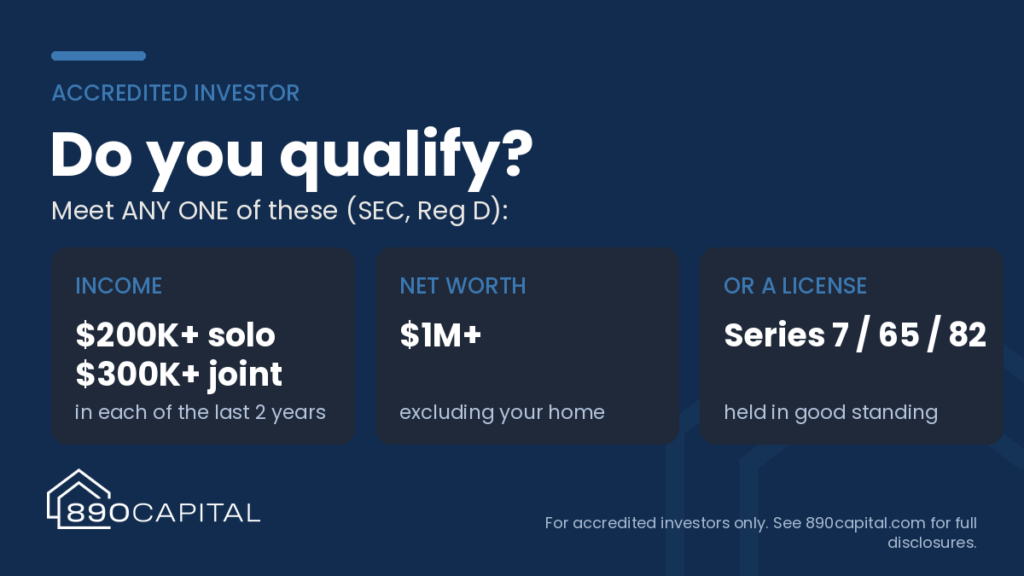
An accredited investor is a person or entity the SEC considers financially sophisticated enough to invest in private offerings that aren't registered with regulators. The definition lives in Regulation D, Rule 501. For individuals, there are two main financial paths, and you only need to meet one.
Income: more than $200,000 on your own, or more than $300,000 jointly with a spouse, in each of the last two years, with a reasonable expectation of the same this year.
Net worth: more than $1,000,000, alone or with a spouse, excluding the value of your primary residence.
There's also a credentials path. If you hold a Series 7, Series 65, or Series 82 license in good standing, you qualify regardless of income or net worth. Certain entities, trusts, and "knowledgeable employees" of a fund qualify too.
You don't apply to the SEC for a card. You either meet the standard or you don't, and for some offerings the fund has to verify it.
Why private funds are required to ask
Most private real estate funds raise capital under Regulation D. 890 Capital uses Rule 506(c), which lets us talk about the fund publicly but limits who can actually invest to accredited investors.
The logic is investor protection. Registered public securities come with heavy disclosure requirements. Private offerings skip a lot of that, so the rule limits them to people who, by income or net worth, are presumed able to evaluate the risk and absorb a loss. It isn't a judgment about how smart you are. It's a regulatory line, and we're required to stay on the right side of it.
How 890 Capital verifies accreditation
Because we operate under 506(c), self-certification isn't enough. Before you invest, we confirm your status through a third-party verification letter from your CPA, attorney, or registered advisor, or by reviewing income or asset documentation. It's a one-time step, it's straightforward, and our team walks you through it.
Once you're verified, the rest is simple. 890 Capital makes first-position hard money loans to vetted operators in the Charleston tri-county, those loans pay interest, and that interest funds monthly distributions to investors at 10% APY, paid by the 5th. You can request investor access to start that process.
Do you qualify? The quick checklist
Run yourself against any one of these: did you earn more than $200,000 single, or $300,000 with a spouse, in each of the last two years? Is your net worth over $1,000,000, not counting your home? Do you hold an active Series 7, 65, or 82 license? If you answered yes to any of them, you almost certainly qualify. The official SEC explainer is worth a read for the edge cases: see the SEC's accredited investor definition.
If you're not accredited yet
We'd rather be honest than salesy. If you don't meet the threshold today, 890 Capital isn't available to you yet, and we won't pretend otherwise. The standard exists for a reason. What you can do is keep learning how the structure works so you're ready when your situation changes. Our monthly Easy Cashflow newsletter breaks down how private lending generates predictable income, and the rest of our blog covers the mechanics in plain English.
For many people the gap is smaller than they think, especially once a spouse's income or a few years of asset growth are in the picture. Accreditation is a line you cross once, and then a different set of options opens up.
The short version
"Accredited investor" isn't a club with a secret handshake. It's an income or net-worth threshold set by the SEC, and funds like ours are required to confirm you meet it before you invest. If you clear $200K in income, $300K jointly, or $1M in net worth outside your home, you're likely there. From our side, the rest is the part we think should be boring: first-position Charleston real estate loans, paid monthly, by the 5th.
Request investor access to see the full 890 Capital offering and start verification.
For accredited investors only. Past performance does not guarantee future returns. See 890capital.com for full disclosures.