Dividend reinvestment in real estate: how a DRIP compounds your monthly income
Dividend reinvestment in real estate is one of those ideas that sounds complicated and turns out to be almost boring. You decide, once, whether this month's income gets spent or goes back to work. That single choice, repeated every month, is the difference between a flat line and a curve.
At 890 Capital, most investors take their monthly distribution as cash. A growing number don't. They route it back into the fund through the 890 DRIP, our dividend reinvestment plan, and let it compound. Same fund, same first-position Charleston mortgages underneath it. The only variable is whether the interest keeps earning.
What dividend reinvestment in real estate actually means
A dividend reinvestment plan is a standing instruction: instead of paying your income out to your bank account, reinvest it. Public companies have offered DRIPs for decades, and the SEC has a plain-English explainer of how they work on investor.gov. The mechanics are the same in private real estate credit. Our fund pays interest monthly, by the 5th. If you're on the DRIP, that interest is added to your invested balance rather than distributed as cash. Next month's interest is then calculated on the slightly larger number.
The word "dividend" is a little loose here. What the fund pays is interest on first-position loans, not a corporate dividend. But the plan works the same way a stock DRIP does, so the name has stuck: the 890 DRIP.
The math, in one position
Take a round number. A $100,000 position at 10% APY pays roughly $833 a month.
Take that cash every month and, over five years, you collect about $50,000 in interest on top of your original $100,000. Nothing wrong with that. If you're living on the income, that predictable monthly check is the entire point.
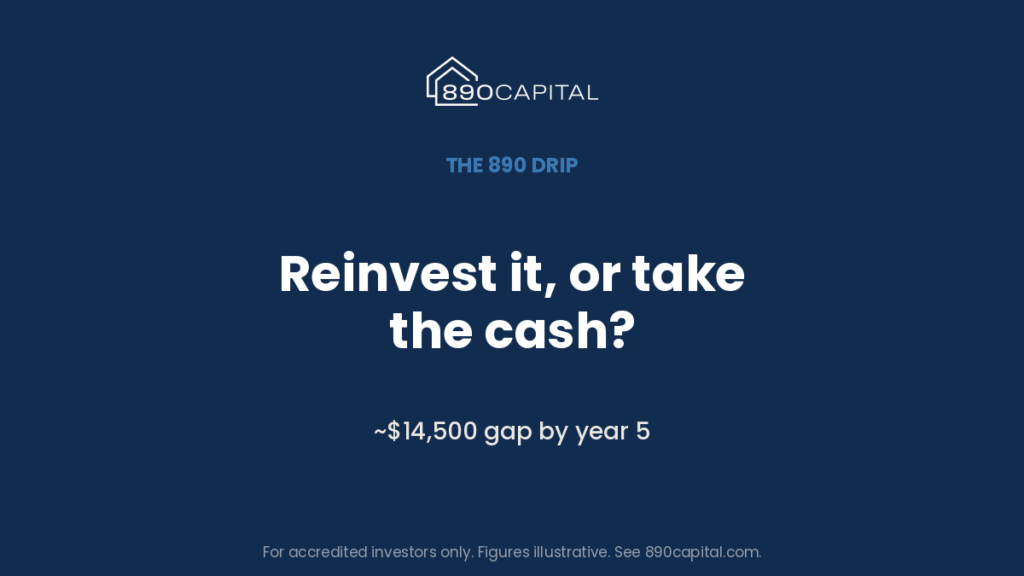
Reinvest it through the DRIP instead, and the same position is worth roughly $164,500 after five years. About $14,500 of that is interest earning its own interest, money the cash version never made. The two paths look almost identical in year one. By year five the gap is real, and it keeps widening every year after that.
These figures are illustrative, compounded monthly, and not a projection or a guarantee. They exist to show the shape of the thing, not to promise a number.
Why the boring version usually wins
There's no timing involved in dividend reinvestment. No trade to get right, no market call, no window you can miss. You make one decision, and then the fund does the same predictable thing every month. That's unglamorous on purpose. Compounding rewards people who leave it alone.
It also removes a small, real friction. When $833 lands in a checking account and sits there earning almost nothing, that's idle money. For investors who don't need the income this month, the DRIP fixes that by putting it back to work on day one instead of letting it wait for a decision you'll make later, or forget to make at all.
Who reinvests and who takes the cash
Both are correct answers to different questions.
Take the distribution if you're using the income now: covering a mortgage, supplementing a pension, paying a tuition bill. It shows up monthly, by the 5th, and you can plan around it. That reliability is why many of our investors are here in the first place.
Reinvest through the DRIP if you don't need the cash this month and you'd rather compound than spend. It suits the investor who reinvests stock dividends without thinking twice, or who is still in the building phase and wants the balance to grow on its own.
The same fund supports both, and you can change your mind. Nothing about first-position lending on Charleston real estate changes based on which box you check. The underwriting, the loan-to-value discipline, the monthly distribution schedule, all of it stays the same.
The engine underneath
Dividend reinvestment only compounds if the underlying income is steady, so it's worth remembering what's actually generating the interest. 890 Capital makes first-position hard money loans to vetted operators in the Charleston tri-county. Every loan sits in first position and is capped at 75% loan-to-value, with the historical average closer to the high 60s. Interest is paid monthly. That predictability is what makes the DRIP work: you can't compound reliably on an income stream that stops and starts.
If you want to see the current numbers and how distributions have run since inception, our monthly investor newsletter is the best place to start. You can subscribe at 890capital.com/easycashflow, or if you're an accredited investor ready to look closer, request investor access.
Dividend reinvestment in real estate isn't a growth stock, and it isn't trying to be. It's slower and a lot more predictable: first-position Charleston mortgages paying interest every month, and a plan that quietly points that interest back into the fund. You decide once. The math does the rest.
For accredited investors only. Past performance does not guarantee future returns. See 890capital.com for full disclosures.